
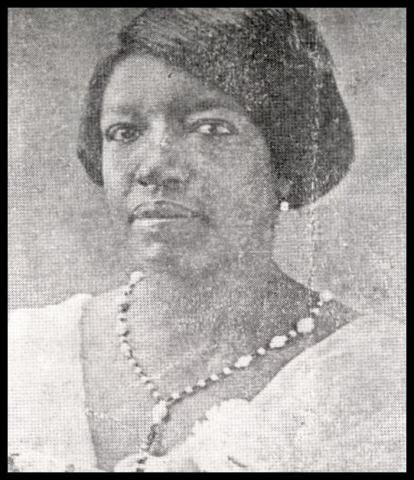
Bossier Parish’s first Jeanes Supervisor, Carrie Martin
Early 20th-century schools for African American children in the South, especially in rural areas, were in a catch-22 caused by a segregated education system that offered less months in the school term, and less years of schooling: You couldn’t have schools for African American students without African American teachers, and you couldn’t have African American teachers without African American schools, especially high schools. Enter a Quaker woman and philanthropist from Philadelphia named Anna T. Jeanes. In 1907 she created a one-million-dollar endowment named the Negro Rural School Fund, more commonly referred to as “the Jeanes fund,” to develop a cadre of educated and professionally trained African American teachers to staff more and better schools for African American children in the rural South, including secondary schools.
Carrie Washington Martin was a school teacher who became the first Jeanes Teacher (often referred to as Jeanes Supervisor) in Bossier Parish, and only the third in the state of Louisiana, in 1913. She was appointed by the Bossier Parish School Board after teaching for a number of years in the Plain Dealing area of northern Bossier Parish.
Carrie Martin was born in December of 1883 in Spring Ridge, Louisiana, a rural part of southwestern Caddo Parish. Her parents were Anthony and Georgia Jackson Washington. Her father farmed and served as a Methodist preacher; census records note that he was literate. Carrie was 16 years old when she married her first husband, Franklin Roan. The young couple lived a few houses away from her parents in Jackson Parish in 1900. Franklin’s fate is unknown, but in May of 1909 Carrie married James C. Martin in Bossier Parish. Her father owned land in the Hughes Spur community, which is near Plain Dealing. Carrie became a school teacher and her husband farmed. Carrie did not have a college degree, but she received teacher training during summer institutes for black teachers. This was typical of the early Jeanes Teachers.
As Bossier Parish’s first Jeanes Teacher, Carrie Martin was charged with providing or improving education for 4,733 African American “educables” ages six to eighteen, and supervising their teachers in 59 schools spread throughout the parish’s approximately 838 square miles. She would likely have been driving in her own vehicle, without travel compensation, on dirt roads that were, for much of the year, mud pits.
In addition to supervising and training teachers in the African American schools, and improving the literacy rate of less than 50% among the parish’s African American population according to the 1910 census, Carrie Martin was also expected to be a leader in school and community health and nutrition, home life, and beautification. As a Jeanes Teacher, she supervised home demonstration (home economics) work for African-American women, such as teaching food preservation, home management skills, and public health by making home visits and organizing homemaker clubs. She also organized community members to raise money to build more or better schools, including by raising livestock or growing cash crops with proceeds going toward a school fund.
Leo Favrot was the state supervisor for Rural Negro Schools and made several visits to Bossier Parish to inspect the schools and the work of Carrie Martin. She was ill during one of his visits, so he called on the parish’s superintendent of schools, W.A. Fortson, to discuss her work. Mr. Favrot concluded from this trip that there was considerable activity on Carrie Martin’s part, but that the Jeanes program did not have secure standing with the Bossier Parish School Board. Mr. Favrot’s suggestion was to win the board over with the usual strategy used at the time to sway a reluctant white community to the cause of education for African Americans– emphasize the practical, industrial nature of the Jeanes Teacher’s work, especially in agriculture.
In 1919, Bossier was without a Jeanes Teacher. The reason for this gap in Carrie Martin’s term is unknown, but Leo Favrot admonished the school board by saying, “This is to be deplored,” because Carrie Martin’s work had “done a lot of good” promoting the interests of schools in Bossier Parish. He hoped the board would resolve to again have a Jeanes teacher and make an appropriation “sufficiently large” to attract a very capable agent. They must have listened, because Carrie Martin was rehired as a Jeanes Teacher the following year.
Carrie Martin passed away on March 11, 1926 from cervical cancer, after an illness of about six months. In recognition for her significant work expanding and improving the educational opportunities available for African American students, the Bossier Parish School Board named the Plain Dealing all-grades school for African American students “Carrie Martin High School” in 1954. After the de-segregation of Bossier Parish schools (1970), the school closed, and Plain Dealing Elementary School opened in the same building. In 2003, community members pressed for the school board to once again have an existing school named to honor Carrie Martin, and Plain Dealing Elementary was re-named Carrie Martin Elementary. In 2018, the elementary school was moved to the campus of Plain Dealing’s middle and high school due to a declining enrollment, but the elementary wing is still named after Carrie Martin, and her portrait hangs in the hallway.
You can visit the Bossier Parish Libraries YouTube channel to watch a virtual slide show on Carrie Maritn, at https://www.youtube.com/watch?v=ig-kWHgY5mw&t=3s or contact us at the History Center if you’d like more information on the parish’s Jeanes Teachers. We are located in the Bossier Central Library Complex at 7204 Hutchison Drive in Bossier City, LA. 2206 Beckett St, Bossier City, LA. Or, go online to our collections database and search for “Catalogs” at http://bossier.pastperfectonline.com/
Please note the new hours for the History Center: M-Fri 9-6. Saturdays we are open by appointment. Our phone number is (318) 746-7717 and our email is history-center@bossierlibrary.org For other local history events, facts, photos, and videos, be sure to follow us @BPLHistoryCenter on FB, @bplhistorycenter on TikTok, and check out our blog http://bpl-hc.blogspot.com/. Contact us if you’d like to be on our email list to receive our newsletter and History Center event updates.
Image: Carrie Washington Martin: 2003 The Yellow Jacket Carrie Martin High School Reunion Yearbook
Article by: Pam Carlisle