
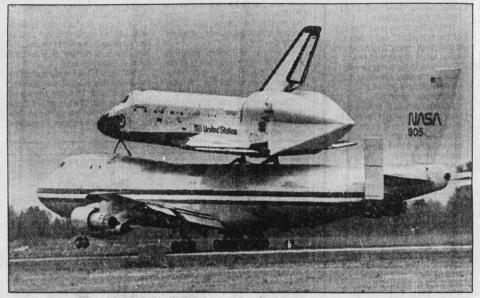
Space Shuttle Columbia Gives Residents Glimpse of the Future
On a frigid Tuesday morning, April 6, 1982, there appeared in the sky over Bossier City a unique object, clad in gleaming white tiles and riding atop a modified 747 jumbo jet. Although not unexpected, its arrival was still a source of wonder and offered a glimpse into the future of space travel.
Columbia, the first vehicle in NASA’s new space shuttle program, was coming to Barksdale Air Force Base. Having recently completed its third orbital mission, it was being carried home to Cape Canaveral in Florida from White Sands, New Mexico, and its “air taxi” needed to refuel. Local newspaper accounts say Barksdale was the logical choice for this task thanks to its long runway and its location approximately halfway between New Mexico and Florida.
Preparations for the shuttle’s arrival began days in advance as a special jet fuel was brought by train for the 747, and Barksdale officials made arrangements for public viewing along the runway. Some schools allowed parents to sign their children out to witness the historic event. An editorial in The Shreveport Times on April 6 perhaps best summed up the importance of the occasion: “Would you like to have seen the Wright brothers’ first aircraft, knowing that it was the forerunner of the awe-inspiring flying machines that have now become routine in the 20th century. The space-age equivalent of such an experience will be available here today.”
This sentiment was not lost on the crowd, estimated to number between 60,000 and 100,000 people, that gathered at Barksdale. Braving cold and windy conditions, they watched with anticipation as the 747 came into view and touched down at about 10:30 a.m. with Columbia riding piggyback. “The spectators were lined up on the runway for hundreds of yards behind the rope barrier,” states a Times article from the following day. “Though the space shuttle was 1,000 feet away, almost everybody had a clear view …” And hopefully that view included an understanding that Columbia represented the nation’s hopes for attaining new goals in space exploration. For the first time, we had a craft that could be reused in our efforts to learn more about the grandeur of the heavens.
While the jumbo jet took on 20,000 gallons of fuel, it also got a change of pilot and copilot for the final leg of the trip to Florida. For two hours, Columbia’s presence graced the runway, as cameras captured on film what an article in the Bossier Press on April 8 described as “another great step in the history that will be written for our grandchildren to look back on.” At 12:30 p.m., the jet took off, carrying the shuttle home where new missions awaited.
On another chilly morning in Bossier City, February 1, 2003, there was very different news of Columbia. Twenty-three years ago this month, the country learned that the shuttle and its crew of seven were gone. Columbia broke apart and disintegrated over Central Louisiana and East Texas returning to Earth from its 28th mission. While investigators sought a cause for the tragedy, Barksdale served as a collection site for the scattered remains of Columbia. The Shreveport Times reported on February 5 that debris was being stored in a hangar on the flight line.
As I watched media coverage, I thought about the shuttle’s visit to Bossier. I thought about how that splendid technical achievement now lay in pieces just yards from where it had been proudly shown to the crowd. And I thought about Shuttle Challenger, remembering where I was in 1986 when I heard the news of its explosion. While researching this article, I learned that Challenger’s commander Dick Scobee was at Barksdale that day in April with Columbia. He was copilot of the 747 during the trip from Bossier City to Florida.
The inquiry ultimately determined that damage to Columbia’s left wing, sustained during launch, led to the disaster. Within a year, President Bush called for the shuttle program to be retired. The last mission was flown in 2011. NASA’s new space program Artemis is underway, with the goal of returning astronauts to the moon, perhaps as soon as 2027. This progress gives us reason to look back and recall with gratitude that moment when we were allowed to witness history.
If you have any photos or other information relating to the history of Bossier City or Bossier Parish, the History Center may be interested in adding the materials to its research collection by donation or by scanning them and returning the originals. Call or visit us to learn more. We are open Monday through Friday 9-6, and Saturday by appointment. Our phone number is (318) 746-7717 and our email is history-center@bossierlibrary.org. We can also be found online at https://www.facebook.com/BPLHistoryCenter/ and http://bpl-hc.blogspot.com/
Images: Shuttle Columbia atop the 747 jumbo jet at Barksdale AFB/photo by Jack Barham/The Shreveport Journal
Article by: Kevin Flowers